
Tech #1071: Machine Learning Algorithms for Toxicity and Cardiac Health (MATCH)
Cardiotoxicity remains a major cause of drug development failure because traditional preclinical models often fail to predict human cardiac responses, especially for complex functional endpoints. MATCH provides a human-relevant, high-throughput platform that integrates advanced cardiac tissue assays with machine-learning analytics to identify unsafe compounds earlier and prioritize safer drug candidates.
IP&C is seeking partners interested in licensing and utilizing MATCH to determine cardiotoxicity, cardiac safety, or functional cardiac activity of pharmaceutical compounds earlier in the drug discovery continuum.
Technology Reference Number
#1071
Inventors
Yu Sun, The University of Toronto
IP&C Contact
Publications
Patents
Patent applications on the MATCH platform are filed in USA and Canada. Proprietary algorithms and difficult to replicate datasets and training models.
Category
Research Tool
Keywords
Cardiotoxicity, iPSC cardiomyocytes, AI‑enabled toxicity prediction, cardiac fibrosis, heart failure
Background
Unpredicted cardiotoxicity and cardiovascular safety concerns remain responsible for the termination of nearly one‑third of compounds in drug discovery pipelines, resulting in substantial cost, time delays, and patient risk. Many existing in vitro and in vivo preclinical models fail to accurately predict human cardiac responses, particularly for complex functional endpoints such as contractility, rhythm stability, and long‑term toxicity.
Regulatory and industry pressure is increasing to adopt human‑relevant, non‑animal preclinical models that can de‑risk cardiac safety earlier in development. MATCH addresses this unmet need by combining functional human cardiac tissue assays with data‑driven predictive analytics, enabling earlier elimination of cardiotoxic compounds and better prioritization of safer, more effective candidates.
Invention Description
MATCH (Machine Learning Algorithms for Toxicity and Cardiac Health) is a high‑throughput in vitro cardiotoxicity and cardiac activity assessment platform that integrates:
- A patented carbon nanotube sensor device
- Optical and imaging‑based functional assays for continuous measurement of cardiac tissue activity
- Proprietary machine‑learning algorithms for data integration, classification, and reporting
The platform incorporates multiple functional tests into a unified, multiparametric system, allowing unbiased identification of the most predictive cardiac metrics for a given compound. By integrating mechanical, electrical, and structural readouts into a single analytical framework, MATCH provides superior predictive power compared to single‑endpoint or ion‑channel–focused assays, setting a new standard for in vitro cardiac screening.
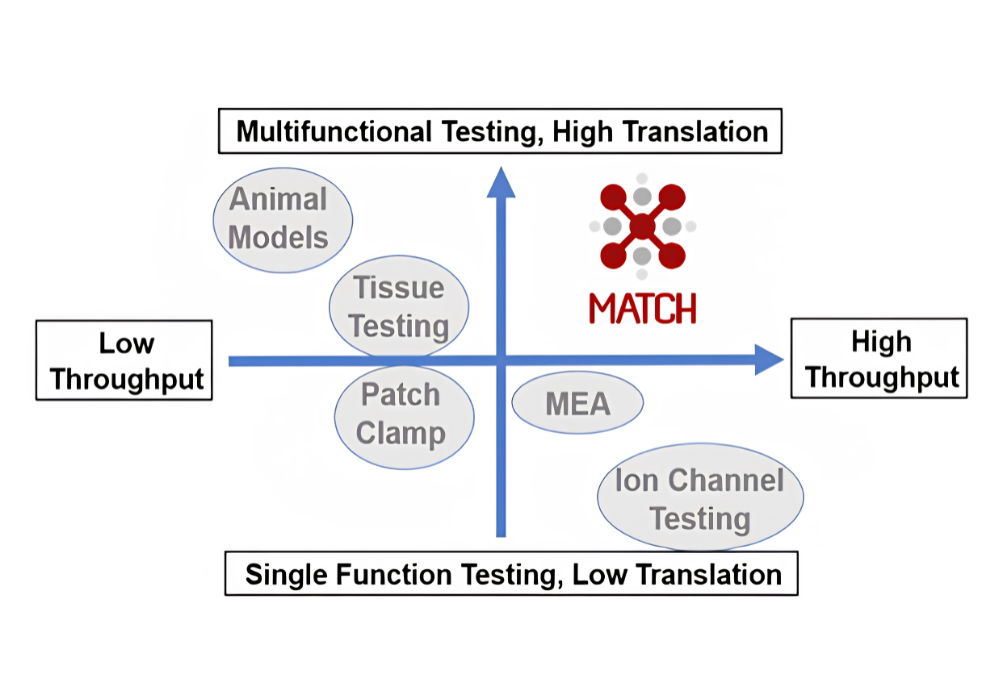
Figure 1.
The pre-clinical cardiac drug testing paradigm currently has a trade-off between throughput and clinical translation/accuracy. MATCH analysis offers the throughput needed for pre-clinical pipeline hit-to-lead compound evaluation with high translation to human in vivo effect.
1. Beating and Contractility Analysis
Developed specifically to analyze drug effect on cardiac tissue composed of induced pluripotent stem cell derived cardiomyocytes (“iPSC-CMs”), which has been shown to be the first platform that recapitulates the in vivo effect of cardioactive drugs.
2. Real-time Tissue Stiffness Analysis
Determine how a compound alters tissue function in the context of a healthy (soft) and diseased (stiff, fibrotic) heart.
3. Drug Candidate Classification and Toxicity Prediction
The above parameters are integrated through a proprietary machine-learning classifier trained on the response of pharmaceuticals of known in vivo activity (Figure 2).
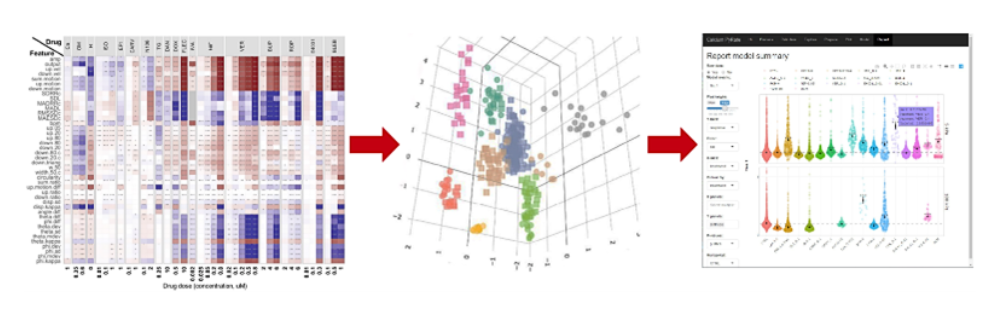
Figure 2.
Drug classification and categorization with putative cellular target identification involving assay response collection (left), drug categorization in ML classifier (middle) and customer report illustrating functional metrics (right)
MATCH analysis has successfully identified the cardiac activity or toxicity of unknown investigational compounds, providing mechanistic insight to customers. We generate a comprehensive user-friendly report that outlines the drug effect on each activity parameter, as well as predictive categorization, without a priori knowledge of the drug to ensure the security of customer intellectual property.
Commercial Applications
MATCH integrates multiple predictive assays into a single platform, generating a comprehensive cardiac functional profile that reduces late‑stage attrition, improves clinical trial success, and enhances patient safety. MATCH has the potential to develop combination-based cardiac drug products.
- MATCH enables systematic identification of drug combinations in which one agent mitigates the cardiotoxicity of another
- Supports the development of cardiotoxicity-mitigating regimens that can rescue the clinical utility of therapeutic assets
- MATCH enables the discovery of novel synergistic combinations (i.e. develop the next Entresto)
Development Stage
Our proprietary assays are patented, and our predictive algorithms are validated using 16 different classes of drug compounds with a known effect on the human heart including: inotropic ions, calcium sensitizers, beta-adrenoceptor agonists, beta-adrenoceptor antagonists, PDE5 inhibitors, SERCA2A antagonists, ryanodine receptor antagonists, funny channel antagonists, calcium channel antagonists (dihydropyridine), calcium channel antagonists (non-dihydropyridine), local anesthetics, hERG antagonists, Nav1.5 antagonists, myosin inhibitors, anthracyclines, and cardiotropic hormones. For each compound, we collect over 40 distinct metrics for quantification, comparison, and categorization. We are currently able to provide drug candidate analyses for hundreds of compounds at a time.
