
Tech #1088: Continuous Negative Abdominal Pressure (CNAP) Device
The Continuous Negative Abdominal Pressure (CNAP) Device is a non-invasive, wearable system that applies gentle continuous sub-atmospheric pressure (−5 to −10 cm H₂O) to the abdomen, drawing the diaphragm caudally to selectively recruit collapsed dorsal lung regions without over-inflating healthy ventral tissue. Designed as an adjunct to conventional ventilation, it enables safer lung recruitment in ARDS patients while they remain supine, preserving line integrity and avoiding the risks of high PEEP or prone positioning.
IP&C is seeking industry partners for exclusive or non-exclusive licensing of this technology.
Technology Reference Number
#1088
Inventors
IP&C Contact
Patents
Category
Medical Device
Keywords
Acute Respiratory Distress Syndrome (ARDS), Mechanical ventilation, Intensive Care Unit (ICU), Lung recruitment, Non-invasive respiratory support, Diaphragm displacement, Dorsal atelectasis, Medical device
Background
Acute Respiratory Distress Syndrome (ARDS) is a life-threatening pulmonary condition affecting adults and children, with mortality exceeding 40% in severe cases and no specific curative therapy.
Lung injury in ARDS concentrates in the dorsal (dependent) regions due to gravity and diaphragm position. Current ventilation strategies—including high positive end-expiratory pressure (PEEP) and prone positioning—are limited:
- High PEEP over-inflates healthy lung regions, increasing injury risk.
- Prone positioning is hazardous: it risks dislodging IV lines, endotracheal tubes, and monitoring catheters.
- No approved device exists that selectively recruits collapsed dorsal lung while the patient remains supine.
Invention Description
The CNAP device is a non-invasive, wearable external pressure system that envelops the patient’s lower chest and abdomen. By applying gentle continuous sub-atmospheric (negative) pressure of −5 to −10 cm H₂O to the abdominal surface, it pulls the diaphragm caudally, selectively expanding the collapsed dorsal lung without over-inflating already-aerated ventral regions.
How it Works:
- A rigid structural frame (flat-panel or adjustable arcuate arches) is positioned to envelop the patient’s lower chest and abdomen.
- A flexible transparent sheet is wrapped around the outside of the frame, extending from the upper chest down to the thighs.
- Two sealing belts—one at the xyphoid level, one at the pelvis—form an airtight chamber between the patient and the device.
- A barb-pipe air inlet on one panel connects to standard wall suction, generating the target negative pressure inside the chamber.
- An integrated pressure sensor and display continuously monitor intra-chamber pressure in real time studies.
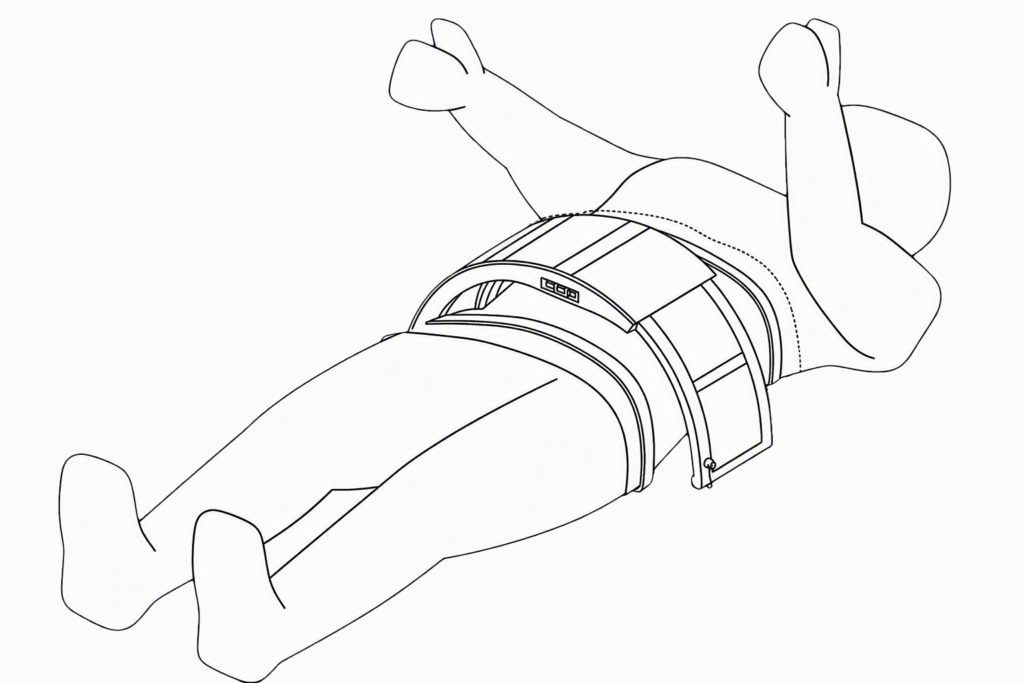
Figure 1.
Continuous Negative Abdominal Pressure (CNAP) device shown in situ over the abdomen of a supine patient.
Key Advantages
- Supine compatibility: eliminates need for dangerous prone positioning, preserving patient safety and line integrity.
- Selective recruitment: targets only the dorsal atelectatic regions without over-stretching ventral lung.
- Universal sizing: scalable frame design accommodates neonates through adults.
- Low infrastructure burden: uses standard hospital wall suction — no specialized pumps or power sources required.
- Continuous monitoring: real-time pressure display enables precise, titrated therapy.
- Haemodynamic safety: no significant effect on blood pressure, pulse oximetry, heart rate, or respiratory rate observed in healthy-subject studies
Commercial Applications
- Adult and pediatric intensive care units (ICU)
- ARDS management as adjunct or alternative to prone positioning
- Post-operative respiratory support
- Neonatal and pediatric respiratory care
- Emergency respiratory stabilization
